After working in the Apache HBase community for a while, I noticed a few relentlessly productive leaders: Michael Stack, contributing day in and day out for a decade, and Duo Zhang, recently promoted to HBase project chair. Stack—a senior engineer I could call “uncle” by age—works across my entire day: morning mail shows a JIRA reply, afternoon another patch, late night comments on someone else’s patch. Duo Zhang—“Duo God” in Lei Jun’s blog—sits to my right. He spends most days in meetings; after work he codes for the community. Most weekends close several JIRAs from Create to Resolved.
I wondered why community leaders invest so deeply. I later heard the term “reinforcing loop” and it clicked: person A does something, gets positive feedback (maybe by chance), invests more, gets stronger feedback, and sustains high effort. Stack and Duo seem on their own reinforcing loops—that drives the commitment.
The HBase open-source community needs a reinforcing loop too: an active team improves HBase; users evaluate alternatives and often choose HBase; satisfied users recommend it; some file bugs, fewer contribute fixes; more people join—promotion, Q&A, sharing, improvement. The community is active—second among Apache projects in 2018 activity metrics. The user base is large, especially in China: HBaseConAsia 2019 live stream drew 20,000 viewers. Unlike some projects, no single commercial vendor owns promotion and education. Official docs and blogs help, but when people asked for a principles book, we were stuck. Fan Xinxin and I wrote HBase Principles and Practice to combine practice with how HBase works.
For engineers, a book costs more effort than code—you switch from precise computation to fuzzy explanation. To stay accessible we added scaffolding, inference, warnings, and summaries so readers can follow the narrative. Turning a rigorous system into a coherent story exhausted us.
Some numbers about the book:
To explain design—not source line by line—we included 200+ figures in 320 pages; effectively an illustrated HBase.
Fan Xinxin, our editor Wu Yi, and I each read the manuscript 20+ times.
Nearly 50 exercises (coding and design) help readers test understanding—the biggest difference from similar books. Speed and difficulty of the problems you solve are the real measure of depth, not pages read or lines of code scanned.
Overall this is a hardcore technical book that explains HBase principles and practice thoroughly—not a light read.
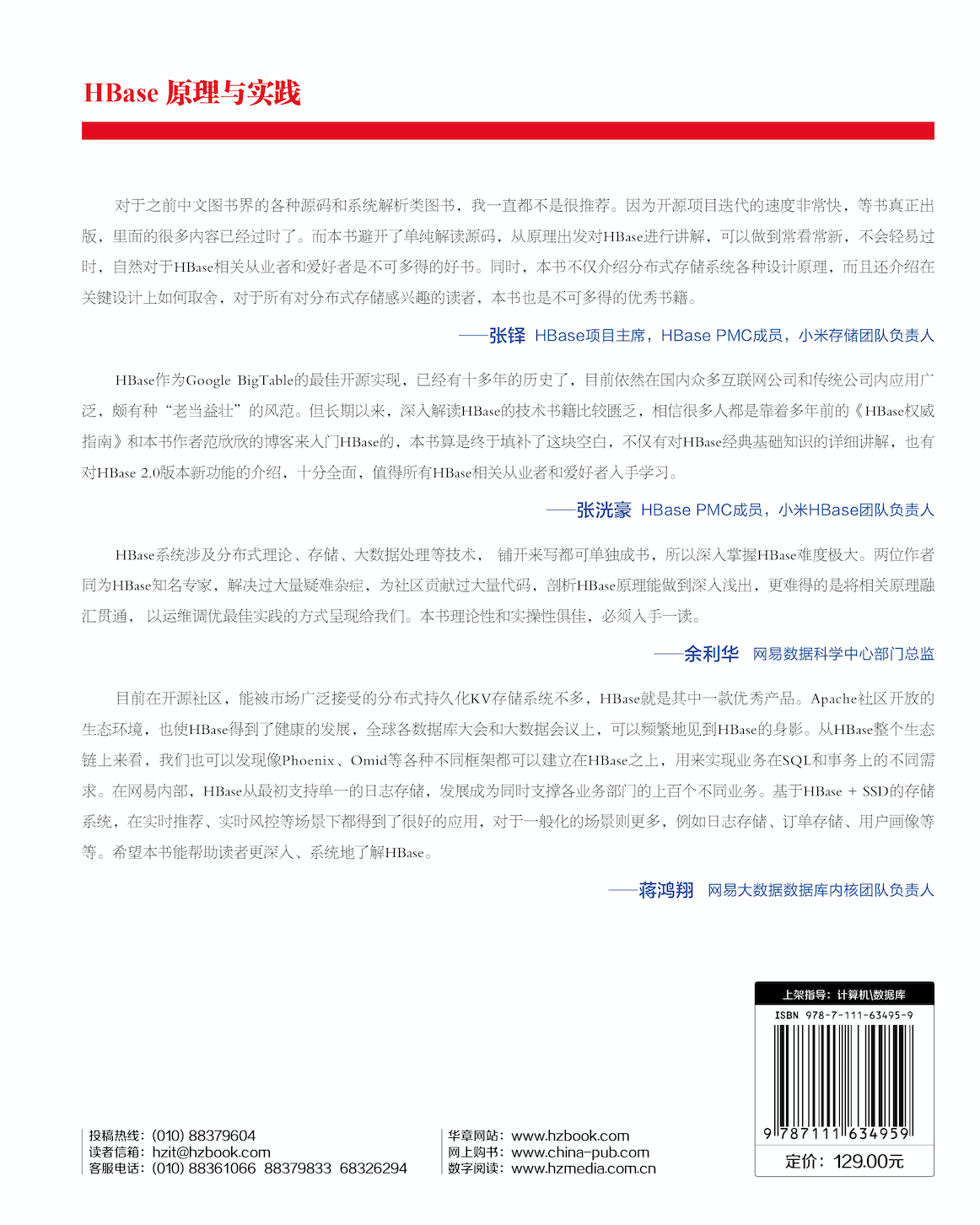
Cover and back cover:
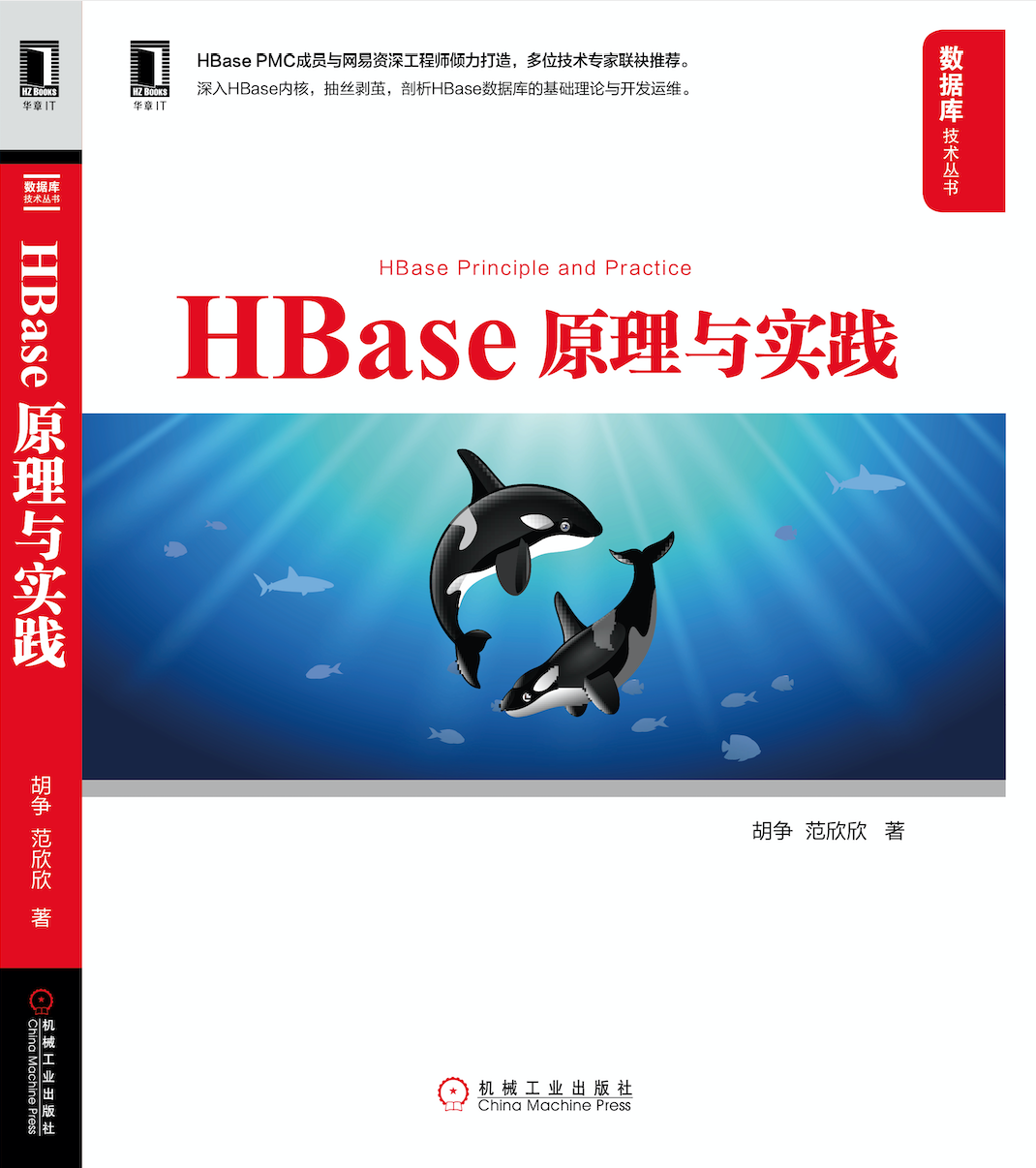
We were honored to have influential peers write endorsements.
Availability
The book ships around September 13, 2019 on major retailers at 129 CNY. During pre-sale (until launch), scan the QR code for 99 CNY and receive: print book + e-book + early author draft. After pre-sale, 129 CNY buys print only; e-book is separate—pre-sale is the best deal. We felt obliged to tell readers; that is partly why we wrote this post.
Pre-order links:
Dangdang link:
JD.com link
Authors
Zheng Hu — HBase engineer at Xiaomi, Apache HBase PMC member; leads Apache HBase development and Xiaomi cluster operations. Long-time Apache contributor and blogger: http://openinx.github.io.
Fan Xinxin — NetEase Hangzhou Research Institute, Data Science Center; HBase and distributed time-series database kernel development and operations. Deep work on HBase internals and many technical articles. Blog: http://hbasefly.com.
Disclosure
Authors have limited say on pricing. Setting price aside, content and layout should be strong. The book uses two-color printing (black and blue), not plain black, for readability.
Roughly 10% of sales goes to royalties split between authors. Technical books that sell 20,000 copies are bestsellers; given HBase’s audience, royalties barely offset ~two years of spare-time work. We did it anyway because we believe the book strengthens the reinforcing loop between users and the HBase community.
This book is for the Apache HBase community. Thanks to PMC members, Committers, contributors, and users—you are all superheroes on this project.